Group Members: Nina Wakabayashi, Ashley Qian, Huizi Cao
Abstract
Our final project, titled “Mapping Layers” focuses on Carleton College’s extensive collection of Japanese maps, which include maps produced by Imperial Japan and the United States Office of Strategic Services (OSS) during World War II. These maps were captured by Allied forces after the war and distributed to libraries across the U.S., including Carleton’s Laurence McKinley Gould Library. Yet, despite their historical significance, these maps have remained largely untouched, obscured by the lack of Japanese translation expertise among the library’s curators. Our project, “Mapping Layers”, seeks to change that. Our team aims to digitize, translate, and analyze these maps to uncover their historical and cultural contexts. We will create an interactive digital archive that makes these maps accessible to researchers, students, and the public.
These maps are more than just geographical representations; they are historical documents that reveal the strategic, cultural, and colonial ideologies of their time. Specifically, we are drawn to the Imperial Japanese maps used during World War II, including one that was used to plan the invasion of Sumba Island, Indonesia. This particular map is uniquely layered with historical data. Originally crafted by the Dutch, it was later modified by the Japanese military with strategic information relevant to their planned invasions. These layers of data—created at different times by different colonial powers—offer a rare glimpse into the evolution of cartographic knowledge and geopolitical strategies. By digitizing these maps and layering their historical contexts, we hope to explore the complex interplay between colonial powers, the narratives they constructed, and how cartographic knowledge was weaponized during the war.
Methodology
Our team, fluent in English, Japanese, and Chinese, is uniquely positioned to bridge the language gap and bring these historical narratives to life. Here’s how we plan to do it:
1. Data Gathering: We will collaborate with Carleton’s Special Collections and Archives and work closely with Professor Asuka Sango to access and study these maps. Our primary focus will be on the map of Sumba Island, which encapsulates the complex historical layering of Dutch and Japanese strategic information.
2. Digitization and Preservation: High-resolution scans of the maps will be created to ensure their preservation and accessibility. We aim to capture every intricate detail, from the ink strokes to the handwritten annotations, preserving the authenticity of these historical documents.
3. Translation and Annotation: Utilizing our multilingual capabilities, we will translate the Japanese text on the maps into English. We will also provide historical and cultural contexts, revealing the strategic intentions, colonial narratives, and cultural representations embedded in the cartography.
4. Analysis: Through text analysis, we will identify key themes such as military strategy, colonial ideologies, and cultural representations.
5. Digital Presentation: We plan to build an interactive digital archive using Omeka or WordPress. The archive will include high-resolution images of the maps, preserving their authenticity, translated text and annotations, offering historical and cultural context, and interactive visualizations using TimelineJS and StoryMapJS, allowing users to explore historical events, cultural significance, and strategic movements through time and space.
Timeline
- Week 7: Finalize project pitch, gather initial data, and begin digitization.
- Week 8: Complete digitization, start translation and annotation, and build the digital archive framework.
- Week 9: Conduct text analysis, create interactive visualizations, and draft project documentation.
- Week 10: Finalize the digital archive and interactive features, prepare the Pecha Kucha presentation, and publish the project.
Inspiration
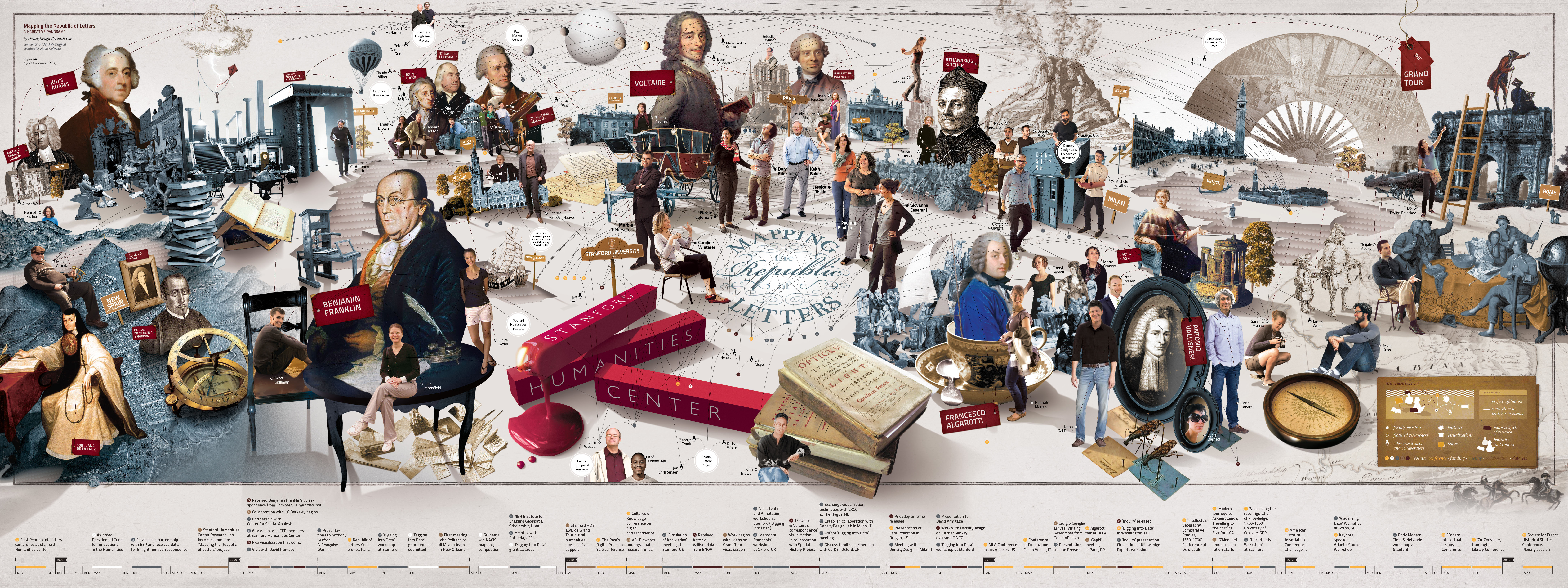
“Mapping the Republic of Letters”, which visualizes the correspondence networks of early modern intellectuals. We aim to emulate its use of interactive maps and timelines to weave complex historical narratives
“The Digital Yokohama Archives”, which integrates high-resolution images, translations, and contextual information, serving as a model for our digital archive’s design and functionality.

I love that you all are getting into what I see as the heart of DH with creating a public resource for others to use in their research! Using your team’s multiliteracy to your advantage to expand the resources available for the project is awesome. I can’t wait to see how far you all go with this project!
Team Mapping Layers,
I love this concept and you all have already made a great start working with Asuka. She has a Mapping Japan website already set up for a few maps in the Omeka S platform, that you might consider adding to, rather than starting from scratch.
We can discuss methods in detail as you get a better sense of what you are working with, but I suggest starting with just simple spreadsheets and text files to organize your data that we can then bring into different tools.
Really excited to see what you accomplish!