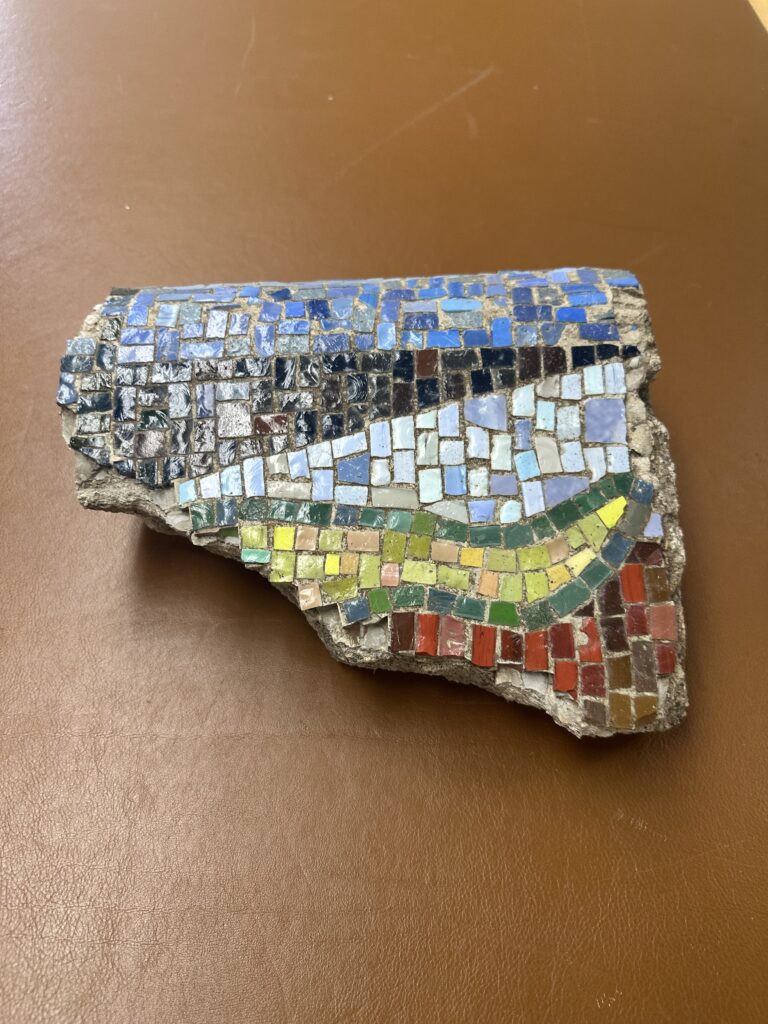
This is a fragment of a mosaic tile from the original site of Carleton College’s Gould Library. The tile features an array of colorful tesserae arranged in a gradient pattern, transitioning from deep blues to vibrant greens and reds. Despite its broken edges, the piece retains a striking composition.
Attempting to model an object is a completely different experience from simply viewing it in an exhibition. In an exhibition setting, you engage with an object as a passive observer, taking in its visual and contextual details but often without a deep, prolonged interaction. When you attempt to model an object, however, you are forced to break it down into its structural and textural components. Every curve, color shift, and imperfection becomes significant. You no longer just see the object as a whole—you see its parts and the relationships between them. This shift in perception can be surprising, as you start to appreciate details that may have gone unnoticed in a casual viewing.
The process of modeling, in particular, encourages an intense level of close looking. Because you need multiple angles and high accuracy, you find yourself paying attention to every minor crack, discoloration, or subtle change in surface texture. This kind of engagement fosters a stronger connection to the object—rather than merely appreciating it as a historical or artistic piece, you begin to ask deeper questions. What caused certain parts to erode more than others? Why were specific materials chosen? How might this object have been used or displayed in the past?
Engaging with objects in this way does make me more curious—not just about the object itself but about the broader narratives it is a part of. A single fragment of a mosaic, for example, becomes a gateway into the architectural history of a place, the artistic techniques of its time, and even the people who walked past it every day. It reinforces the idea that objects are not just isolated artifacts; they are part of a larger web of stories, cultural shifts, and human experiences.
Shifting from a passive observer to an active modeler also changes the way I think about communicating art and history to others. Traditional exhibitions rely heavily on written descriptions and curated displays, but modeling and digital reconstruction open up new ways of engagement. Interactive models allow people to explore objects from angles that might not be visible in a museum case. It makes art and history more accessible, breaking down barriers between experts and the general public. In this sense, modeling is not just a tool for documentation—it is a tool for storytelling.

Woah! Scaniverse actually did an amazing job modeling this one! I like that you brought up the questions having to look more intentionally at an object brings up, I find myself wondering similar things when modeling by hand. It creates a much deeper interest in the object as compared to being a passive observer!
Hi Chloe, I really enjoyed your 3D modeling of the mosaic tile fragment—it looks amazing in the Scaniverse preview! I completely agree with your point that modeling an object reveals its individual parts and the relationships between them. This approach uncovers details that are often overlooked. I also appreciate your insight that modeling is not only a documentation tool but also a powerful storytelling medium for art and history.