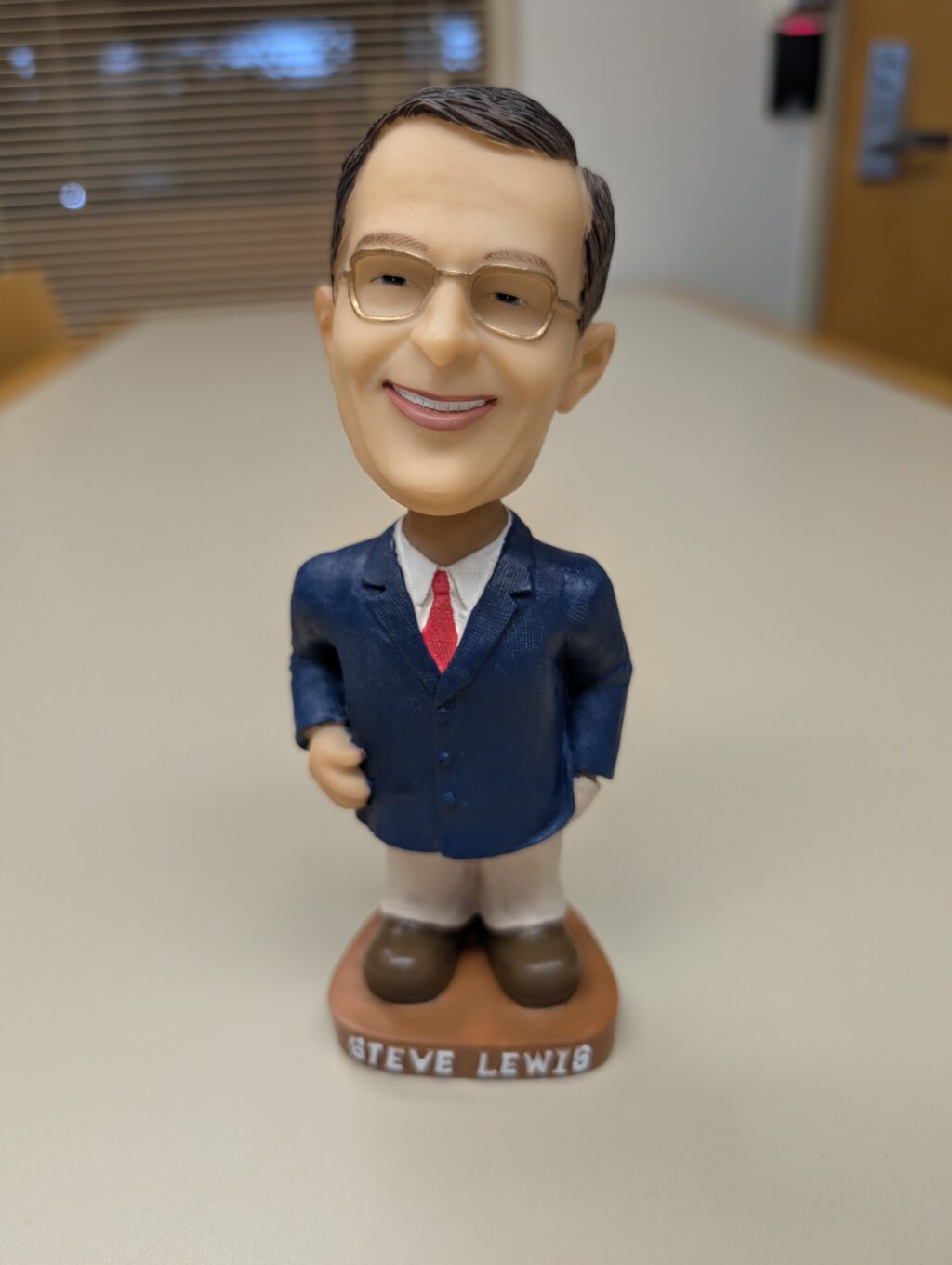
For this week my team, composed of Simon Noble, Sam Much and I were tasked with digitising Carleton President, Steve Lewis’s Bobble-head, link to our item in the digital collection.
As you might be able to tell the object is (as described by the College Archives): “Bobblehead figure of President Stephen R. Lewis Jr.” the reason as for why I chose their description is because the item is for lack of better words, kind of simple, however the process for digitising it was anything but simple, so much so that at the time that I am writing this, it is still not finished!
I think that one of the big advantages of what we are doing at the moment is that it allows us to have a better observe and learn about the object that we are staring at. The reason why I say this is that even if we are not allowed to touch the objects, the fact that we have to pay such detailed attention to how we look at the object since we want to take as detailed of a scan as we are able to, makes it so that you learn more about the object, for example in this case, from the preliminary scan that we created I learnt that the hair is really shiny, to the point that it is hard to properly capture all the details that it has; this is something that I probably would not have paid any mind to if i was looking at it in a museum for example, because I would have paid more attention to the meaning of the object for example or a sort of skim of it from the front most likely (since that is how they tend to present these types of objects in exhibitions).
This closer look that we get to have with withe objects makes it so that we are undoubtedly more curious about why the object was created and why certain decisions were made with it, for example why chose that particular outfit for the figure, is that how he presented himself to the world normally? Or why is his hair parted in that specific direction? Or what event lead to the creation of this object in particular?


I love this statement that you wrote in your blog: “even if we are not allowed to touch the objects, the fact that we have to pay such detailed attention to how we look at the object […], makes it so that you learn more about the object”. I fully agree and after having first hand experience doing it, it is weirdly true. I think that it’s our vision trying to decipher (the job of our hands) to feel the textures and so on, which makes one transcend into wanting to understand more about the object.