Here is the link to the Omeka item.
Throughout the week, my group and I worked on modeling Trophy Duck.
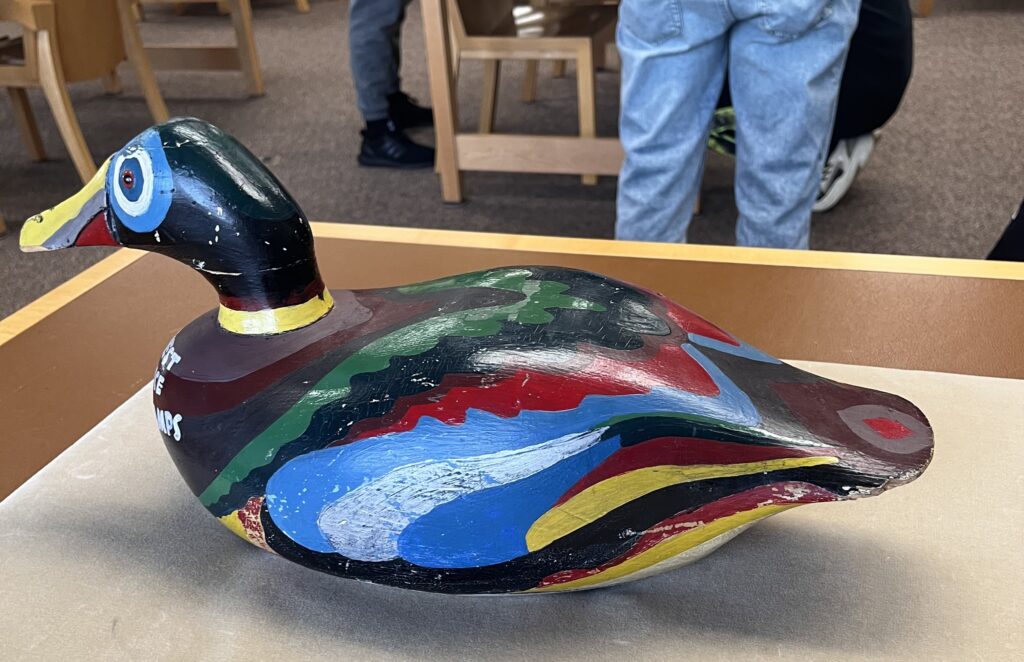
On Tuesday, we used mobile apps such as Scaniverse and Polycams to take photos and videos in order to create an accurate 3D model. Personally, I found it fascinating to see how Polycams produced a more accurate and detailed model compared to Scaniverse. Below is a comparison between the model I created using Scaniverse (right) and Polycams (left). With Scaniverse, the model appears to be made up of scattered dots in various colors, and the overall resolution is quite low. On the other hand, Polycams generated a much more detailed model. A similar experience occurred for my group members, and I’m curious about why this difference occurs.


On Thursday, I attempted to model Trophy Duck using Metashape. With Metashape, there were more manual steps involved, such as uploading photos, aligning and cleaning the images, deciding on textures, and adjusting the resolution. While Metashape offered more flexibility and freedom, I found the process more challenging to follow, and I couldn’t use it intuitively at first. However, given the range of options available, I’m eager to continue using the software and improve my comfort with it over time.
Overall, I believe photogrammetry encourages close observation and attention to details that might otherwise be overlooked. Normally, when I look at an object, I tend to focus on the general impression it gives from a distance and feel satisfied. However, this project made me pay attention to the small details, offering a more thorough, 360-degree examination of the object to create a comprehensive model. I started to consider how highlights and shadows are formed by the unique shape of the object!
Engaging with objects in this way sparked my curiosity and made me wonder about the stories they could tell. For example, why was the trophy modeled as a duck to begin with? And why did it end up at Carleton, even though other schools that won the Midwest swimming competition also owned similar trophies? These questions have sparked a desire to uncover the untold stories behind the object. I’ve come to realize that the process of archiving requires responsibility, accuracy, and honesty, as the way we communicate information to the public can shape its perception. This reflection has made me more aware of the potential for storytelling and the importance of creating reliable and truthful archives.

Thank you for including the side by side pictures of your Scaniverse and Polycams models. My group had a similar experience with varied success rates depending on the platform we used. It’s cool to compare the results of each program knowing they started out with the same data and processed it wildly differently. Nice connection between your own experience with this project, archiving, and storytelling. Well done!
Hi Nina! I found it interesting that you had difficulty using Scaniverse for your 3D model, as my group didn’t experience the same issue with it appearing as scattered dots. However, we did find it more challenging to 3D model fluid shapes that are less rigid. My group did not try using Polycam but your model turned out great so I’m interested in giving it a try next time!
Hi Nina! I had the opposite problem with the photogrammetry apps. We actually got a better model after using Scaniverse compared to Polycams, but I’m glad your team had success either way. I had a similar experience with creating our 3D model where I became more curious about my object’s history. For me, I think the modeling process sparked curiosity because I was spending an extended amount of time with the object (compared to if I saw it at a museum) and looking at it from many different angles, which made me wonder about the object more.
I agree with how you said these types of projects encourage attention to minor details whereas before you would just consider the overall impression it gives. I think that by going through this process it really allows us to look at these objects from a completely new and different perspective that we otherwise would not have even considered.
Hi Nina, I think despite the difficulties you guys had with the app, you guys did a good job on your model as it looks well developed. I agree with you that this process requiresa higher attention to detail compared to a normal exhibition, and it can make engaging with the item a lot easier and more interesting. As I analyzed every detail of the item for my model, I became interested in the object’s history.