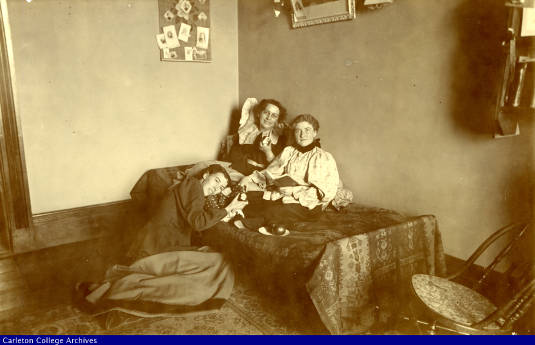
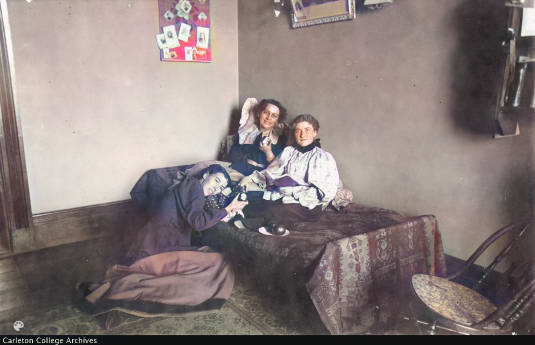
For this week’s lab assignment, I colorized a photo of female students spending time together in a dorm room. This photo comes from Carleton’s Digital Collections and was originally black and white. By using artificial intelligence, I was able to quickly and easily bring this photo to life with the addition of color.
Here is my Omeka Item.
Artificial intelligence is great for straightforward tasks such as data analysis and pattern recognition. However, I am apprehensive about its ethics when it comes to the arts. AI is programmed to recreate images and tropes that we have chosen. As a result, the objects it produces lack originality and creativity. If we rely on AI for artistic practices, individual stories and worldviews will be suppressed by unimaginative and biased images.
Obviously, no one can speak for all writers, but let me make the argument that starting with a blurry copy of unoriginal work isn’t a good way to create original work.
Ted Chiang
Ted Chiang’s article ChatGPT Is a Blurry JPEG of the Web does an excellent job of illustrating the ethical risks of AI-produced work. Originality comes from unique perspectives and ideas. If we rely on what has already been created, we will never produce work that challenges the dominant viewpoint. AI systems are trained by selected data and if that data is not diverse or biased, the AI can perpetuate the unfair treatment of certain groups. Concerning image manipulation, there is currently a lack of guidelines on what can be altered especially regarding people. These images can be misused and lack the consent of those portrayed.
At their core, art historians study the ways in which art can offer insights into how people once saw the world. They explore how works of art shaped the worlds in which they were made and would go on to influence future generations. A computer algorithm cannot perform these functions.
Sonja Drimmer
Another great quote comes from How AI is Hijacking Art History by Sonja Drimmer. In this article, Drimmer expresses her apprehension about promoting artificial intelligence for undercovering lost works of art without considering the biases and deceptions that come with these programs. Art historians examine how art reflects the perspectives and experiences of those who came before us, something artificial intelligence is unable to grasp. During this time when AI is something new and fun to explore, it can be difficult to step back and examine what is truly happening and what populations are being harmed.

Hi Lydia, I really appreciate your concise reflection! In the color restoration version, I noticed that the girl with her head on the bed had a much more pale and grey complexion than the other girls sitting on the bed. Her face almost is the same color as the wall. It seems almost as if the computer recognized her as part of the bed and the wall, causing that entire segment of the photo to be generalized and treated in the same way. This art restoration project a perfect piece of evidence about how AI is generalizing and lacking in nuance.