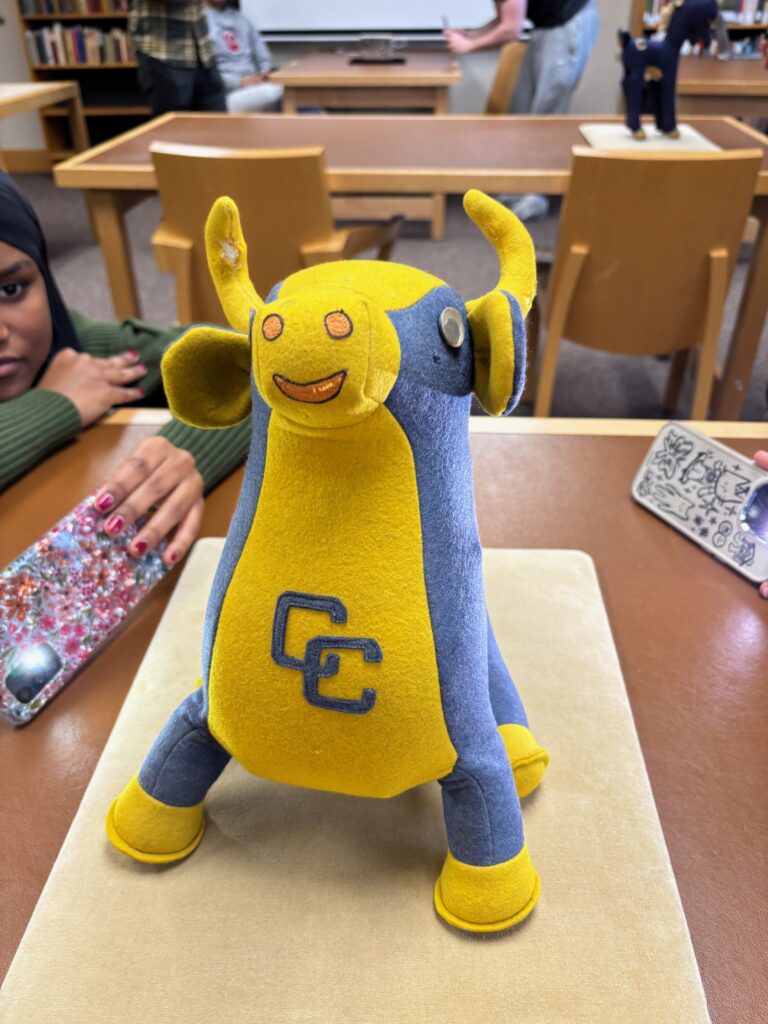
Our group decided to photograph and create a 3D model of the bull. There’s not much information available about it, aside from the fact that it comes from Carleton. I enjoyed exploring the 3D scanner apps and was pleasantly surprised by the results (I expected them to turn out worse). The light box scanner also looked interesting, so I’m hoping we can try it out in the future.
Here’s the link to our Omeka item: https://dgah.sites.carleton.edu/digitalobjects/items/show/159.
Going through the process of modeling an object, rather than just observing one in an exhibition, made me feel more connected to the piece in a way. While photographing and scanning, we made sure to capture all angles, which helped me notice the details that I might have missed if we hadn’t done the modeling.
This experience highlighted the value of being an active modeler. Physically moving the object and examining it from different perspectives, as opposed to the limited view in an exhibition, allowed me to appreciate it more. Using the apps made the process much easier compared to hand modeling. However, I think hand modeling, like we did previously, would have deepened our attention to detail, as it would have required a more precise form of close looking.
I used Polycam for the 3D scan, but I have to admit that the model we made with Scanaverse had slightly better clarity and detail…this could be due to the quality of my Android camera. After seeing the results garnered from the Polycam app, I think that it would be better to use the light box for a more professional and crisp model. But in the future if Polycam improves their app, and if the user has a good camera and lighting, I think that it would be possible to have a detailed scan. Since I don’t have Polycam Premium, here’s a video of the model, as I can’t insert an interactive version:

Yes, I definitetly had a similar experience modeling the objects! You definitely feel more connected and discover more when you’re actively moving around the object and trying to capture all the tiny details. Our group actually had a pretty good experience with polycam, it could also be that the bull is too harshly lit causing the colors to look weird? Great job trying to get all the angles! My group really struggled with getting into the crevices of the object without touching it- we had the marching band hat so it was difficult to get the soft fabric details.
I think that 3D model is really good and I appreciate you also reflecting on the quality of the model. I feel like my group had trouble with the modeling because of how difficult it was to register shiny surfaces even though we were trying to be active modelers. I feel like this would look amazing in that white box with the spinner since the colors would pop way more on a white background.
I agree that scanning an object really helps you feel more connected to it. I have only used Scaniverse so far, and I had a great experience, so I would love to try Polycam. Having the digital camera and balanced light would definitely make a big difference, so I am interested to see how the lightbox turns out.
Hi, thank you for your interesting posts! Your reflection provides a great balance between technical observations and personal engagement with the object. It’s interesting to see how your expectations of the 3D scanning process evolved, and your comparison of different apps adds a practical dimension to your experience. The point about hand modeling requiring more precise observation is particularly thought-provoking. Do you think there’s a trade-off between convenience and a deeper connection to the object? It would be fascinating to see how different modeling methods shape our understanding of artifacts.