As a History major, I was drawn to The Georgetown Slavery Archive as a DH project to explore. The archive, which was launched in 2016, is continually being updated with new sources and community engagement. The project was begun by the Archives Subgroup of the Georgetown University Working Group on Slavery, Memory, and Reconciliation, whose members at the time included Adam Rothman, Marcia Chatelain, and Matthew Quallen, the former of whom teach at Georgetown and the latter of whom attended as a student. A digital archive, much of the purpose of this project is to make these sources accessible to a wide audience of scholars, descendants, and other interested individuals. Based at a college, there is also an element of engaging with Georgetown’s historic engagement with enslavement.
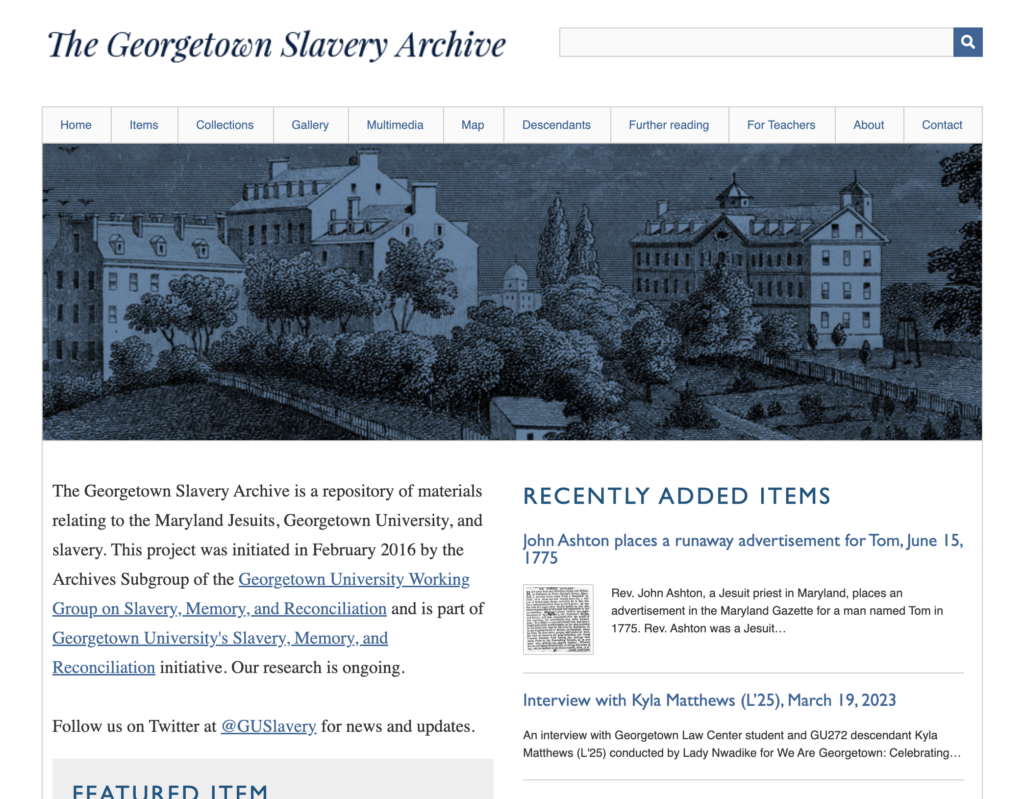
The Slavery Archive draws from the Maryland Province Archives of the Society of Jesus at the Georgetown University Library. These materials, which date from 1715 to 2023, document “Jesuit slaveholding and Georgetown University’s own historical ties to the trade of enslaved individuals.” Examples of sources include letters, bills of sale, income reports, newspaper advertisements, and government petitions.
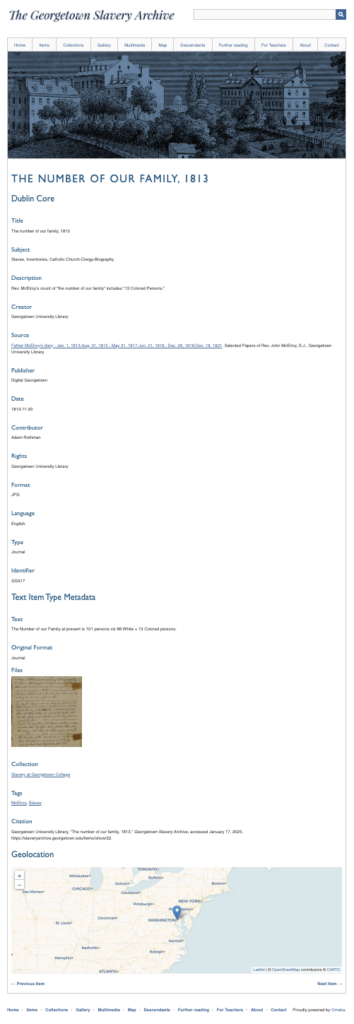
Each source is digitized such that it can be examined in its original form. Information such as author, date, title, subject, type, and other data needed for citations is provided (as is a citation), as well as a full transcription of the text. Sources are labeled with a thematic collection and tagged with descriptors or names shared with other sources. Finally, many sources are geotagged; a map is provided on an individual source’s page that shows its origin. Users can also access a comprehensive map that shows all sources. By processing the data in this way, the collection is easily searchable and readable for all audiences.
The presentation of this project is fairly simple. Users can browse sources through a list of the entire archive (available chronologically or by identifier number), look through individual collections, engage with a gallery of featured documents, or learn more about any of the other resources by clicking on various tabs of the webpage. A typical source page looks like the figure at right.
After engaging with the Georgetown Slavery Archive, I am curious to know more about the future of the project. As it continues, will its members continue to focus on the digitization and organization of sources or will there be a transition to analysis and engagement with descendants?
