
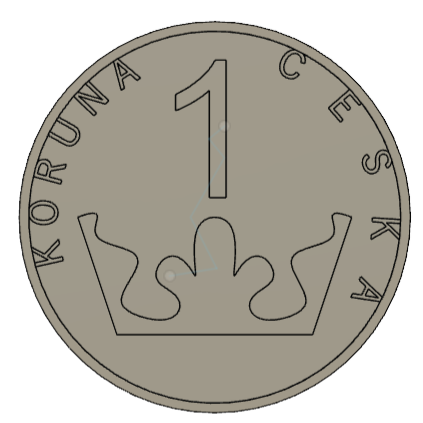
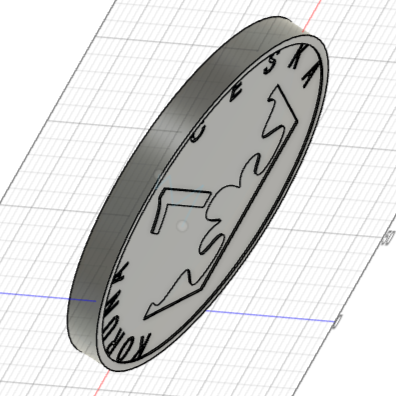
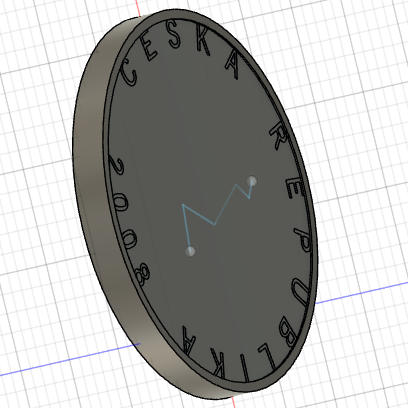
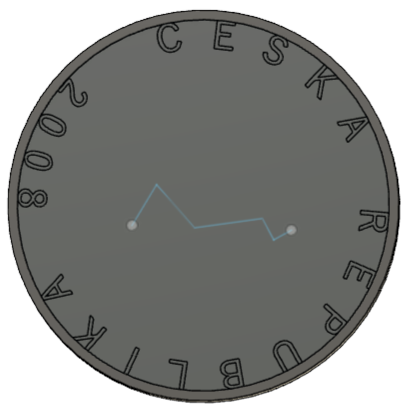
For this project, I decided to create a 3D model of a Czech Koruna. During the summer before my senior year, I studied abroad for the first time in Prague, and I kept one of my coins as a souvenir.
I don’t know if I would describe my process of making this 3D model as simply easy or hard, but it was certainly time-consuming. I spent about two hours in the library on Tuesday perfecting my sketch of the crown on the top side of the coin. I experienced a few bouts of frustration when I wasn’t able to fully get the hang of a specific tool, but despite this learning curve, I had quite an enjoyable time. I was able to put on my music, tune out the world, and focus all my attention on creating the 3D model, and I never found myself becoming bored or annoyed at completing this project. To put it simply, I had a fun time!
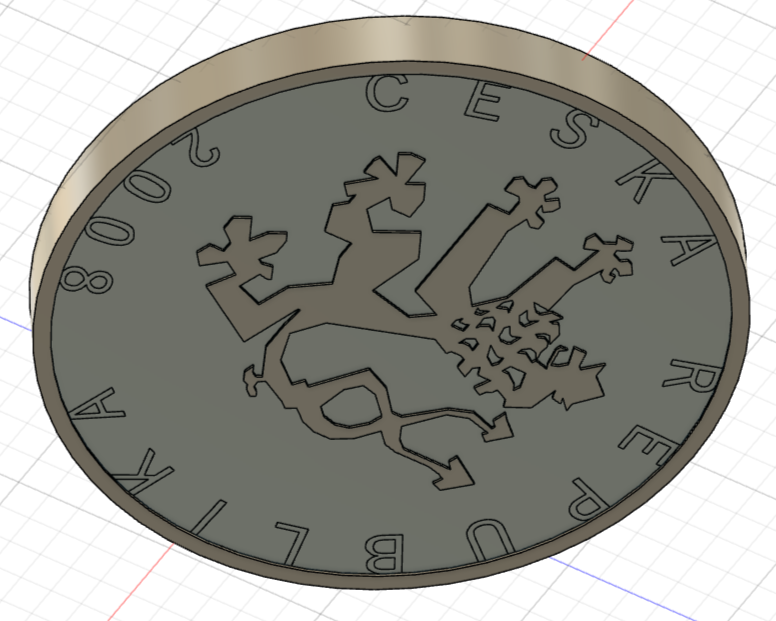
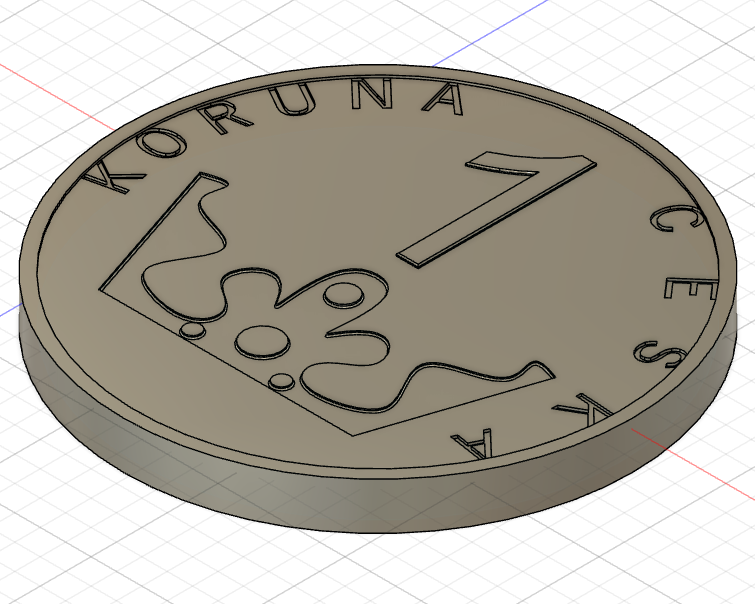
There were a couple elements of creating my 3D model that I had trouble with, but I was able to either learn how to fix my problems or make compromises so that the model looked the best it could with my current skill level.
- Firstly, I had trouble creating sketches on specific planes
I spent quite a while fiddling with Fusion in order to make the text firstly, wrap around a circle, and secondly, appear on specific sides of the coin. However, I was able to fix this by clicking on the specific face of the coin that I was working on before creating my sketch.
- Secondly, I had problems with making the sketches and extrusions look how I desired
I had many errors appear on my screen after trying to use the extrude and fillet tools that told me I was unable to make specific parts indent or extend in the ways I wanted them to. I had to compromise by only using the extrude tool on specific parts of the coin. Additionally, I also had a difficult time drawing more organic shapes like the rounded edges of the crown and the lion. I settled for a more simplified version of these engravings when making my sketches.
- Finally, it was personally hard to keep specific parts of the coin in separate sketches
Specific parts of my 3D model would have been better if they were kept as separate sketches. For example, the details in the lion’s mane on the bottom of the coin could have been a different sketch so that the engraving could have been extended further than the rest of the lion, like how it is on the actual coin. However, I drew the details of the mane in a sketch with the entire lion and could not figure out how to make the details extend higher without extending the height of the entire coin. I had to settle for not extruding the details and extruding the rest of the lion. Additionally, the “CESKA REPUBLIKA” text is attached to the face of the coin, so I do not know how to extrude those parts so that it is indented like the text on the other side of the coin.
I believe this tool could be used to teach 3D art classes. My friend Luis is currently taking Elements of 3D Art and Design here at Carleton, and I think Fusion could be used to make a prototype of his projects. This would allow Luis and other 3D art students to be able to try out different ideas using trial and error without exhausting many resources.
One tool that I found particularly useful for rouding edges was the Fillet tool. This made the extrusions not so harsh and look much more like the engravings of a coin. This tool could also be used for rounded objects like water bottles or chapstick.

Hi Trixie!!! It’s really impressive how you navigated the challenges of creating your 3D model and found ways to adapt! I can definitely relate to how tricky it can be to make organic shapes and align sketches on specific planes. I really liked your suggestion about using Fusion for 3D art classes—it makes a lot of sense to use digital prototyping to experiment with ideas before committing to physical materials. I thought tools like Fusion could bridge the gap between digital and traditional art forms! For example, using a 3D model as a base for more handcrafted elements might create some cool hybrid pieces.
I’m so impressed by the organic shapes on the crown! I also think that the proportions on the coin are spot on and I love seeing such a complex animal represented on the back through little sketches. The use of Fusion 360 to help 3D artists create base models from their ideas without expending a lot of resources also got me thinking how this program could make artistry less resource intensive and possibly more accessible to people who do not have the resources to make multiple prototypes.