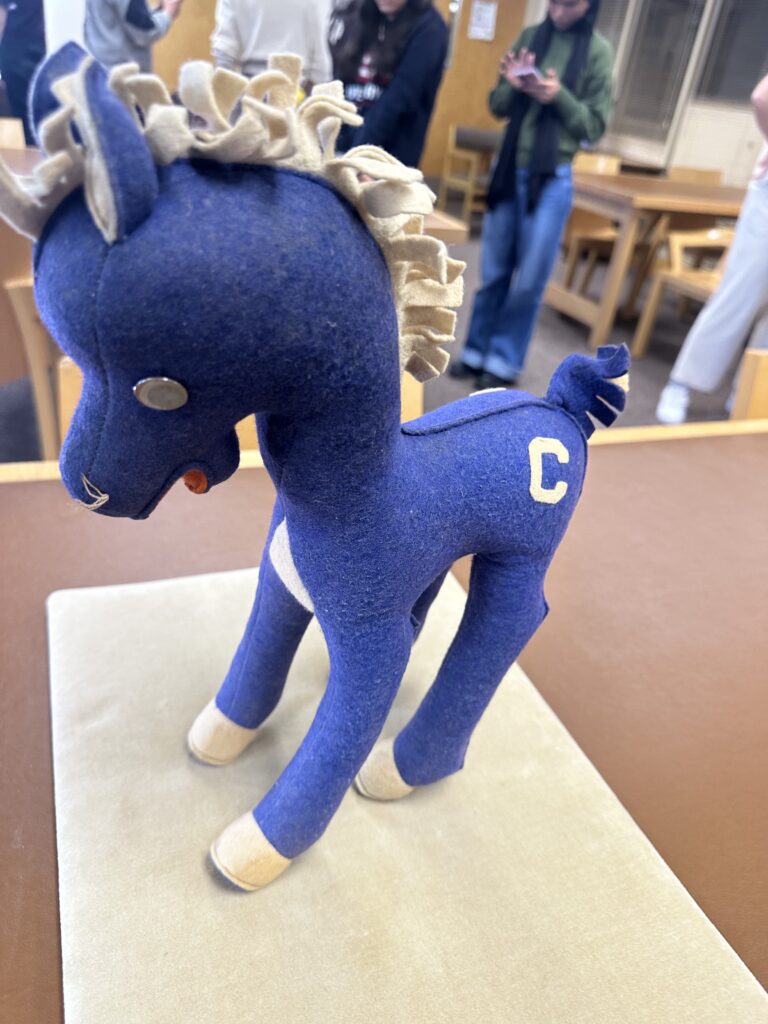
My group and I chose the horse stuffed animal as our object to 3D model. While we considered modeling the beer can because of its simple shape, we decided that its metallic, shiny material would be hard to photograph with our limited lighting equipment (phone flashlights) and chose the felt horse instead.
Attempting to model this horse as opposed to viewing it in an exhibition greatly enhanced my interaction with it. In order to model the horse, my group and I were tasked with photographing all realizable angles of it without touching the artifact. This photography process required us to carefully perceive and thoughtfully interact with the space around the horse. If I were to view this horse from behind glass, it would have been a more two dimensional experience and different parts of my brain would not have been engaged. Being close up to take the photos allowed me to understand my own proportions relative to the horse, my hands relative to the horse’s body, legs, and head. This proximity allowed me to take in subtle details I most likely would have overlooked from behind glass: the horse’s mouth, chin, curves, materials. In all honesty, my attention span—like most people that use social media—is relatively short so modeling the horse allowed me to take my time and make observations about the object that would not have been made in a five second time frame.
After this project I am curious as to what specific, tangible choices artists make to translate their experiences and beliefs into their work. Thinking changes from passive to active in communicating about art and history to public:
By creating models of objects, interacting with content on a deeper level, and practicing the adjacent methods to original makers, we can develop a better understanding of their artistic process and become aware of the choices they made when creating art. Being able to identify and better understand these choices allows us to come closer to each artist’s unique perspective and their human experience.

I really like your questions about the choices that artists make in order to translate their experiences and beliefs into their work. While I mostly approached this model thinking only about the physical detail I could see, I think you bring up the important point of considering what caused those details to exist. If part of the point of creating models such as this is to increase understanding and access to objects, it makes total sense to analyze physical details as providing insight into artists’ perspectives and experiences.