Our group chose the Carleton Marching Band Hat for our 3D imaging project. Overall, the process was intuitive and easy to figure out. The only challenging part was producing a completely error-free 3D image. The project can be found on Omeka here. Also, example 3d images from our project can be seen below.

Overall, the 3D model turned out well. Being able to interact with the model in a 3D space allows for a more natural way to observe and interpret the object. While images can provide the same information, having to navigate between different angles is unintuitive and disrupts the observer’s ability to focus on interpretation. The only drawback of the 3D model is the lack of detail. While this issue might be resolved with better software and a more controlled setting, the current images lack fine-grained details. Additionally, some portions of the model were not accurately represented. The image below provides an example of these shortcomings.
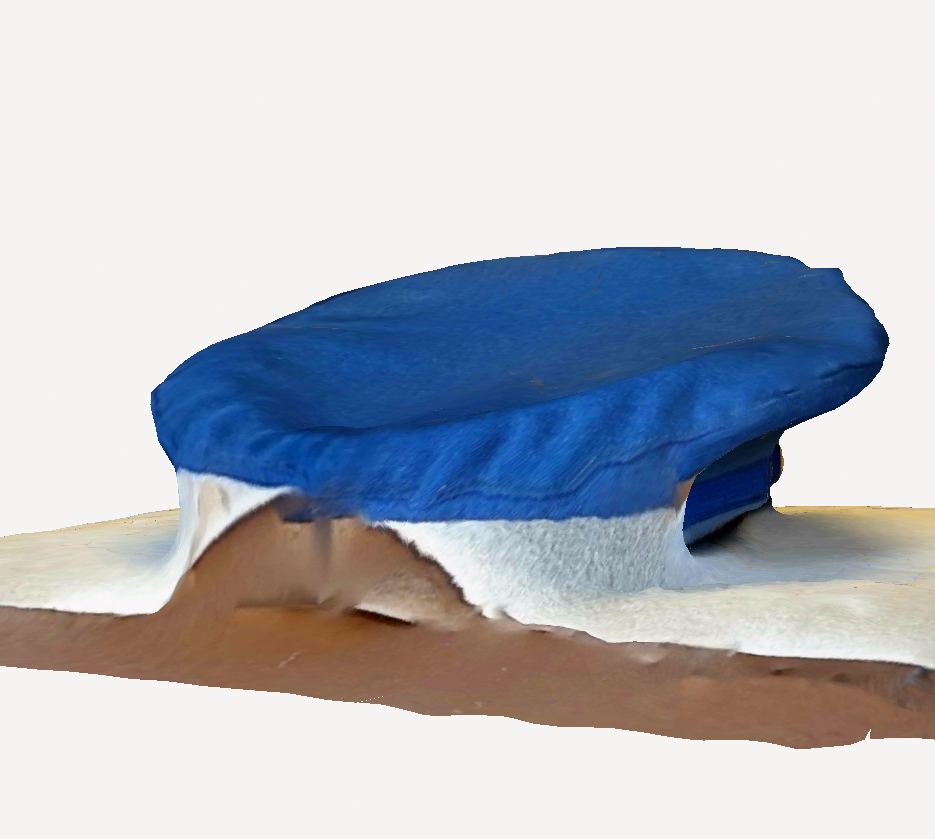
Due to the uncontrolled setting, specifically the uneven lighting caused by the close proximity to a window, the software struggled to create an accurate model from all angles. In this case, the table and mat merged into the top edge of the hat. Despite multiple attempts and the use of different software, our group had difficulty generating a completely accurate model. Secondly, while the model allows for zooming in, the level of detail is not ideal. In my opinion, if fine details are of utmost importance, still images remain the best option. That being said, with a more controlled environment—such as a light box, a turntable, and a high-quality camera—the resulting 3D model could be significantly improved. While our group was unable to use these options, it is possible that a 3D model could achieve the same level of detail as still images.
Overall, 3D models can be a viable option for representing physical objects if captured in the right setting with the right software. In the humanities, they offer a unique way to share and preserve objects in a format that closely resembles interacting with the object itself. This allows researchers to analyze the object as if it were in front of them, leading to better research and results.
