This week, my group members and I have been working with Berit Olsdatter Egge’s Bible. This bible dates from around 1815 and belonged to a student at Carleton. It is written in another language, likely Norwegian, and has significant wear from devoted use throughout the years. I was drawn to this item because it was one of the oldest items available for us to model and looks like it has a lot of history behind it. Here is our Omeka item.
Attempting to model an object requires a lot more attention compared to simply viewing one in an exhibition. When I am viewing collections in a museum, I often go quickly between objects and rarely stop to examine things in detail. However, when it comes to modeling, I was forced to slow down and focus solely on one object. The process required me to truly inspect the artifact and learn its history. Another aspect that modeling allows for is playing with lighting and angles, something you are unable to do in a set exhibition. Overall, I really enjoyed this process and the possibilities it holds for the accessibility of artifacts.
I would say that the process of Photogrammetry encourages attention to detail, however, I believe other methods for creating 3D models require closer observation. For example, during the first week of this course, we used the platform Fusion360 to create our own models. This process forced me to examine and measure my object which admittedly took more time. When it came to using Scaniverse, the technique was a lot faster and did not require as much problem-solving. As I reflect on both processes, I can see both having benefits regarding what you are creating. If I were tasked with modeling a detailed historic artifact, I would rely on Photogrammetry to capture its detail. However, if I had to make a simple model of a small item, I would model it by hand.
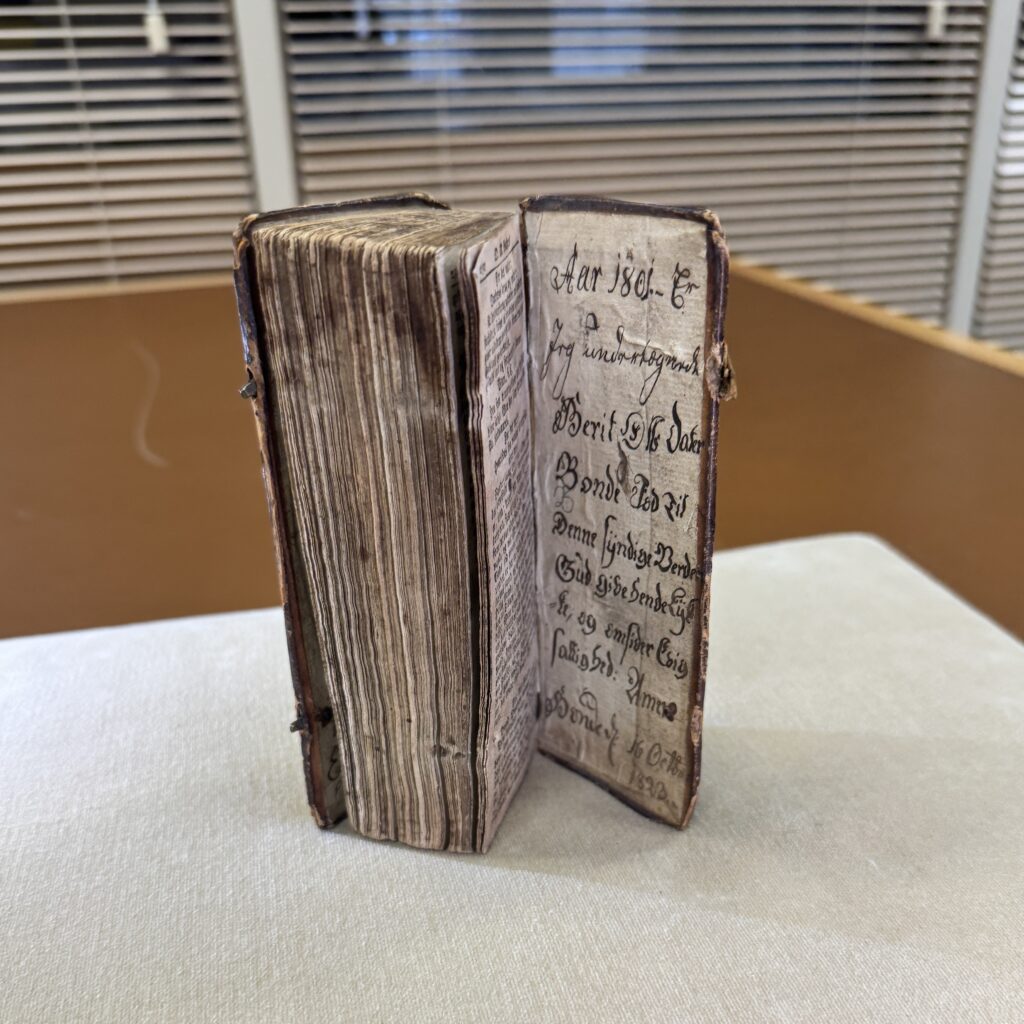

Out of all the objects, I think this one is the hardest to 3D model. An open book with so many pages and text must be really challenging! I’m really curious if just using a phone to take photos can actually capture all those details. Your modeling process and reflections are really interesting, and I totally agree that artifact accessibility is important. In my art history class, I’ve seen cases where restoration actually damaged an artwork, and the only record of its original state was a few blurry old photos. Because of that, we couldn’t fully appreciate what the piece originally looked like. That’s why I think 3D modeling is so important—it helps preserve objects in a way that keeps them as true to their original form as possible.