Ethics of AI in Image Manipulation
Our class discussions about the use of AI to manipulate images has reminded me of something that happened online about a year ago. To understand the situation, here is some context about Keith Haring, as his work is a major part of the story. Keith Haring was a prominent pop artist who is especially known for the simple human figures in his paintings. He used his artwork as a form of social activism, and one cause that he especially brought awareness to was the AIDS crisis. Unfinished Painting (1989) is a painting by Haring that is true to its title. It was intentionally left unfinished to represent how his life was going to be cut short due to his own battle with AIDS.
In December 2023, following a conversation online about artworks that provoke strong emotional reactions, a Twitter user used AI to “finish” Haring’s Unfinished Painting.
The story behind this painting is so sad! 😢
— Donnel (@DonnelVillager) December 31, 2023
Now using AI we can complete what he couldn't finish! ❤️ https://t.co/RuASoTfFdk pic.twitter.com/uAwM6SBUGW
I believe this image manipulation completely negates the original message of Haring’s work. The incompleteness of the painting is supposed to provoke a sense of sadness; the viewer is supposed to be reminded of the impact that the AIDS crisis had, particularly on the queer community. Additionally, it is also important to note that the AI image did not do a great job at recreating Haring’s art style. It’s devoid of Haring’s iconic human figures and instead opts for random geometric shapes. By “completing” the painting, and in a manner that does not effectively pay tribute to the artist, the use of AI to manipulate Haring’s painting raises ethical concerns.
[Art historians] explore how works of art shaped the worlds in which they were made and would go on to influence future generations.
A computer algorithm cannot perform these functions.
Drimmer, Sonja. “How AI Is Hijacking Art History.” The Conversation, 3 Dec. 2024, theconversation.com/how-ai-is-hijacking-art-history-170691.
As Sonja Drimmer points out, the use of artificial intelligence can strip art of its cultural impact and meaning, especially if the people who are using AI to manipulate images do not enter art and art history spaces with the understanding of the cultural and personal context that influence artists to make their works.
At the same time, there are important cautions. As Jessica Marie Johnson warns, the drive for data and the building of databases for historical research are not outside of histories of commodification, exploitation, and violence, which she calls on us to account for.
Lauren Tilton, Relating to Historical Sources, The American Historical Review, Volume 128, Issue 3, September 2023, Pages 1354–1359, https://doi.org/10.1093/ahr/rhad365
This quote from Lauren Tilton that references Jessica Marie Johnson corroborates my point. I believe it is important to understand the context in which certain works are produced before we use AI to manipulate them. We must recognize that works like Unfinished Painting are not made in a vacuum and hold historical significance. We must not uphold a facade of joy if in the process, we are erasing the very real pain that lies underneath.
Colorizing Carleton Photos
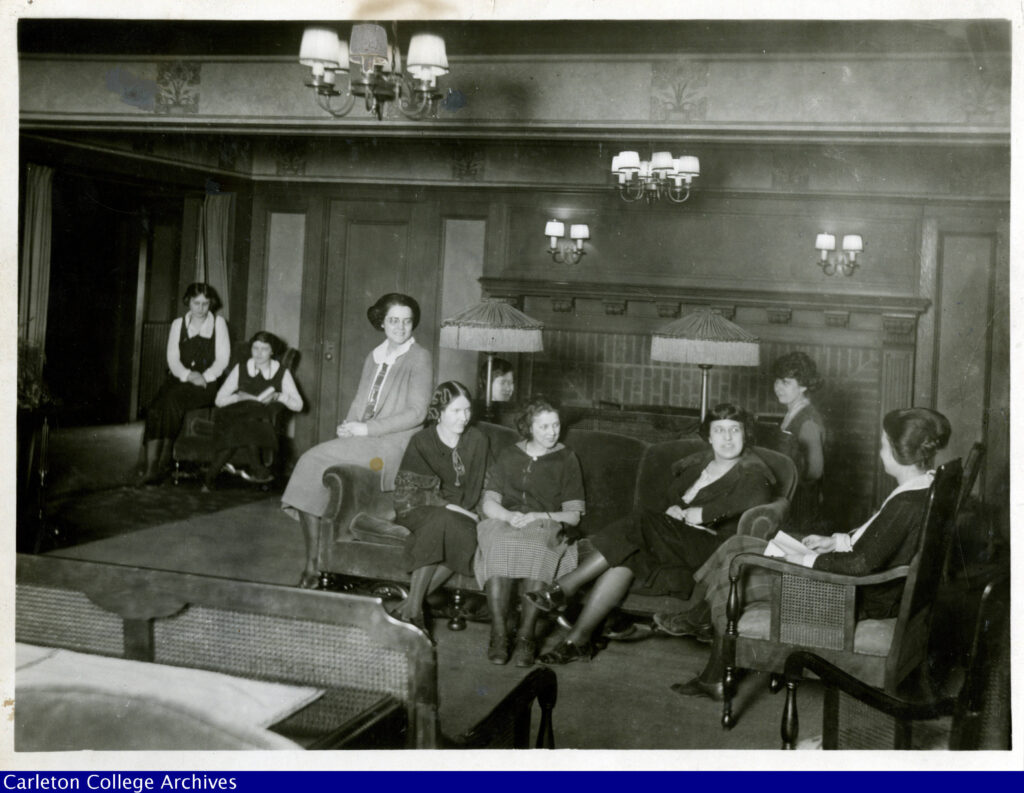
My Omeka item can be found here. The colorizing process was somewhat fun, and I was interested to see what the product would look like. However, the ease of the process could raise concerns. Because image manipulation is becoming as simple as inputting a photo and pressing a few buttons, it can be easier for the historical context of the original image to become lost, just like with the example of Unfinished Painting.


Hi Trixie! I love that you could link this lab assignment to a personal experience you had, and I agree that it corroborates the ethical concerns AI can pose. Haring’s painting and its AI ‘recreation’ demonstrate a specific lack of cultural attachment and style that AI attempts to generalize. I also found it alarming that the output wasn’t even similar to his original work, as this completely strips away the authenticity of how the artist’s paintings looked.
Hi Trixie. I appreciate the way you illustrate how AI-based “completions” can distort an artist’s original intentions, especially with Keith Haring’s Unfinished Painting. Your point about AI’s simplicity potentially erasing painful histories is spot on, and your references reinforce the need to understand the broader cultural contexts of artworks. It’s clear that art isn’t created in a vacuum, and your example powerfully underscores how easily an artist’s message can be lost.