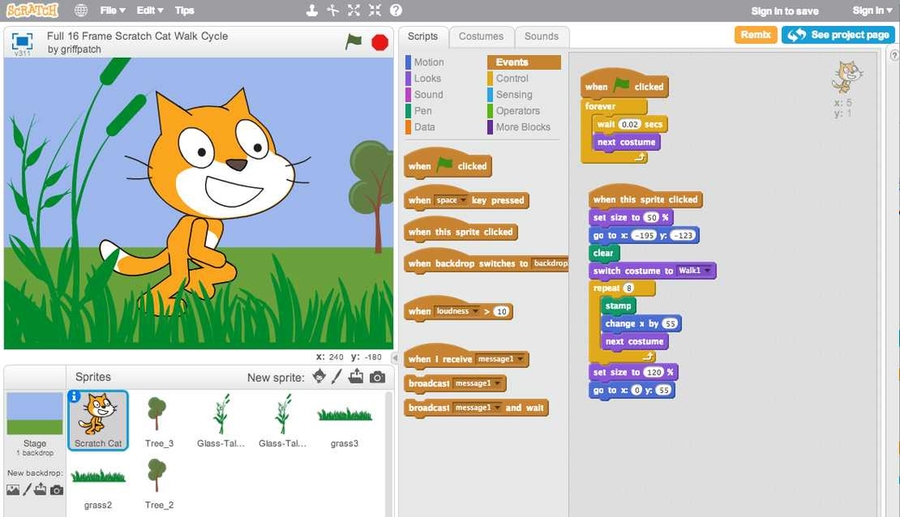
I don’t believe every humanities student should learn to code. Considering my personal coding experience, I might be a little biased in this debate. When I was in primary school, I learned “SCRATCH” in my computer science class—a graphical programming language regarded as a pretty easy tool for young children to experience coding. Although I excelled in all academic subjects (by academic, I mean language and math classes), I found that the kids with the lowest grades in my class were better at coding than I was. They finished coding tasks while I was still trying to figure out what each part meant. As an overly competitive child at the time, this hurt me deeply. Since then, I’ve avoided anything related to coding because it felt like exposing a weakness. As a result, I’ve always been resistant to programming.
As I grew older, I began to realize that nobody is perfect; we all have things we’re not good at. For me, that’s coding. The idea of specialization is to let people focus on what they excel at so they can make the greatest contribution. For example, in a game development company, there are programmers who write and test code to ensure it works, but there are also game designers who conceptualize character skills and their unique styles to differentiate them, as well as illustrators who create character designs to attract the target audience. In this context, game designers generate ideas, and programmers execute them. Forcing everyone to code is akin to turning everyone into programmers—who then designs the game, creates the characters, or ensures the game can be published? That’s why I reject the notion of forcing everyone to code. There are already enough coding enthusiasts in the world; compelling everyone to code will only lead to an oversupply of programmers.
I want to respond with an alternative solution to what Kirschenbaum claimed in his article to end my statement:
I believe proficiency in a computer language can fulfill many of the same functions — accessibility, self-reliance, heightened critical awareness — as knowledge of a traditional foreign language.
“Hello Worlds (Why Humanities Students Should Learn to Program).” Matthew G. Kirschenbaum, May 26, 2010. https://mkirschenbaum.wordpress.com/2010/05/23/hello-worlds/.
My response: Learning to code is not the only way to improve accessibility, self-reliance, and critical awareness. Moreover, it’s often better to gather people with specialized skills than to rely on one person with a broad but shallow skillset.
Below is the coding snippet I wrote to create a tic-tac-toe game in my intro to computer science class. This is a perfect example to illustrate my point above: I believe the person who invented the Tic Tac Toe game for people to enjoy is just as important as those who wrote the code to make it playable.
def didPlayerWinWithColumn(boardState, player, col):
    firstcolumn = []
    secondcolumn = []
    thirdcolumn = []
    for col in range (0,3):
        firstcolumn.append(boardState[col][0])
        secondcolumn.append(boardState[col][1])
        thirdcolumn.append(boardState[col][2])
    if player ==1:
        if firstcolumn == [1,1,1]:
            return True
        if secondcolumn == [1,1,1]:
            return True
        if thirdcolumn == [1,1,1]:
            return True
        else:
            return False
    if player ==2:
        if firstcolumn == [2,2,2]:
            return True
        if secondcolumn == [2,2,2]:
            return True
        if thirdcolumn == [2,2,2]:
            return True
        else:
            return False

I was initially on the opposing side of the argument, but you raised some really valid points. I agree that specialization plays a key role in contributing to a larger project, and forcing everyone to code may not be necessary. Your analogy to game development and the importance of specific roles makes a strong case for why coding shouldn’t be a universal expectation for all.
I appreciate your argument on why not everyone should learn to code. I agree with you, coding is a difficult task that requires an extreme amount of patience, persistence, and practice. It is simply not fun to be constantly struggling. Furthermore, I agree that nobody should be forced to learn how to code. In fact, if you are only interested in learning the basics of coding, I recommend going through an online tutorial such as HTML Dog rather than taking a full introductory course in computer programming.
I love your focus on specialization and how two people may have differing interests that may or may not involve coding. I also remember learning a simple coding program like Scratch growing up, and it was interesting how some students excelled at it and others didn’t. I appreciate your consideration of how sometimes it is better for someone to be a coder and others to be enjoyers of pre-made code.