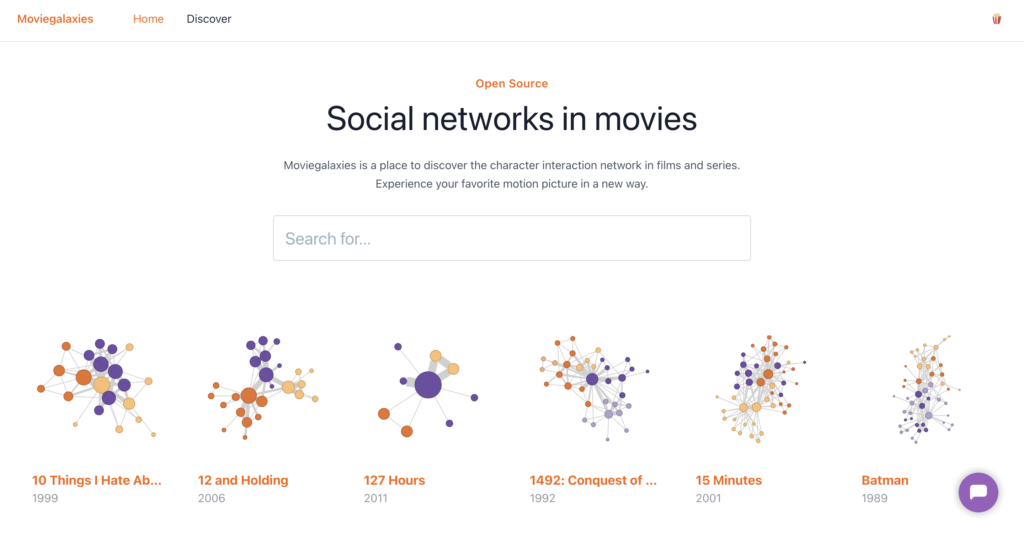
Movie Galaxies is a website designed for movie enthusiasts, providing character interaction networks in films and series. This website is very interesting and straightforward. I will analyze this website in-depth according to the post requirements.
Black Box
The data for this website comes from the Harvard Dataverse, which was created by a Harvard professor using a movie script parser. They determined the same-scene appearance of characters as a proxy for connectedness. During the data collection process, the authors used programming techniques to read movie scripts and also employed a small amount of manual work to correct errors made by the program. When presenting this project, the authors used a network format to display various nodes and connections, combining images with data to showcase the database. This combination makes these data very clear.
Question I Have
While breaking down the project, I had questions about the latest data processing methods. On Harvard’s website, the analysis of movies ended in 2012, and the code used was last updated in 2018. However, this website continues to be updated in 2025. This makes me wonder whether there have been any changes to the code over the past seven years. If more advanced text processing technologies were used, how would the results differ? This is something I am very curious about—the impact of technological advancements on sociology and other disciplines.
In-class Discussion Questions
This website was discussed in class, and I would like to add on to the discussion. First, who is the audience for this website? In my opinion, aside from movie enthusiasts, researchers in Cinema Studies would also find this data highly valuable. Since the website categorizes movies by genre, researchers could analyze how different genres require varying numbers of characters and levels of relationship complexity, which could provide inspiration for screenplay writing.
Another question I would like to delve into is: Does the site make an argument? While the website itself does not present any explicit argument and simply displays data, it’s important to note that the data collection process is based on subjective text analysis. Although the numbers themselves are neutral, the method of data collection may introduce biases. Let’s imagine a scenario: some directors design highly intricate character relationships, but their scenes are relatively simple in terms of character interactions. If character connections are determined solely based on whether two characters appear in the same scene, the connections might seem sparse. On the other hand, if more advanced text analysis techniques were employed, the character relationships could appear much more complex. This highlights the biases introduced by technological methods in data collection, which I believe is a point worth reflecting on.
